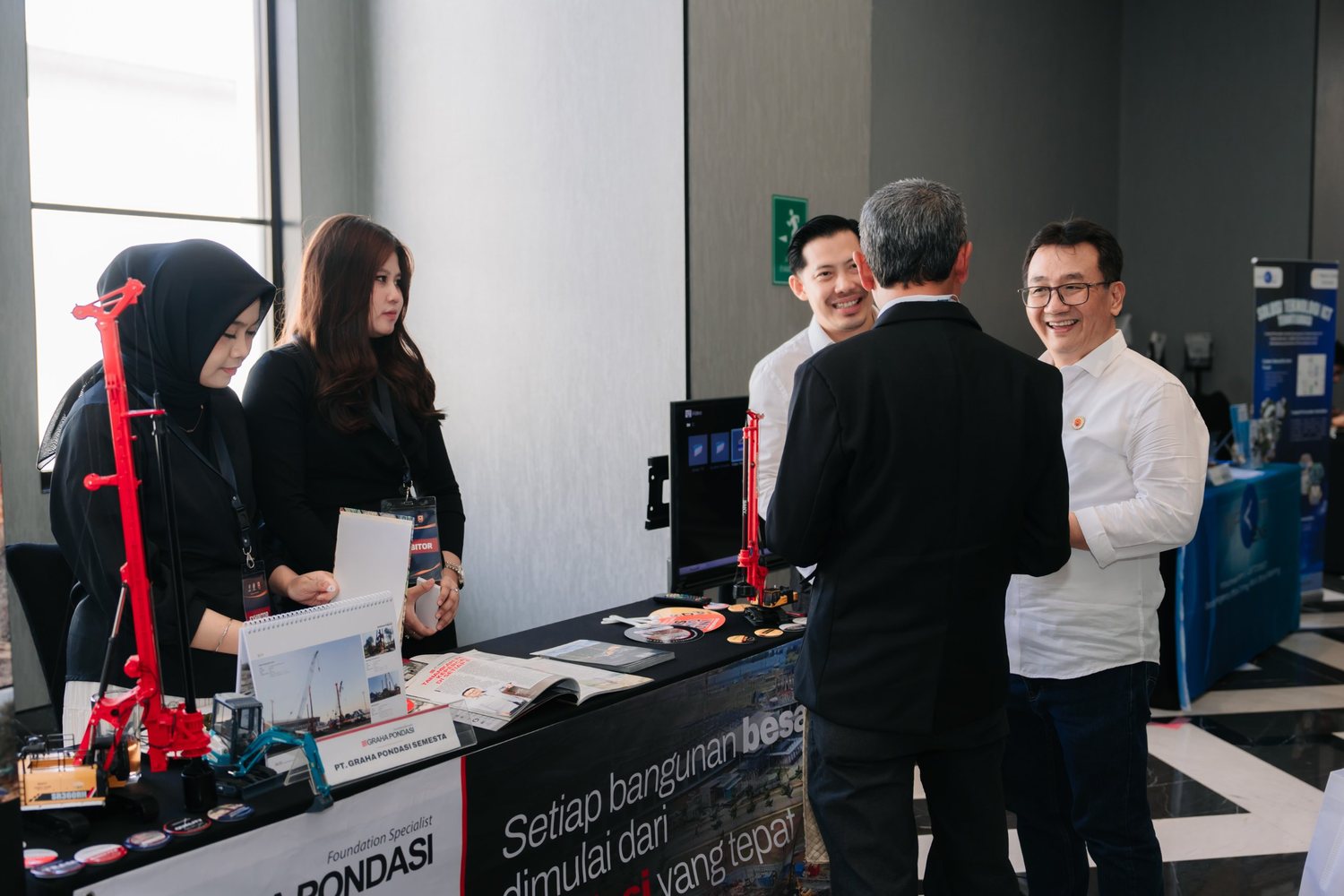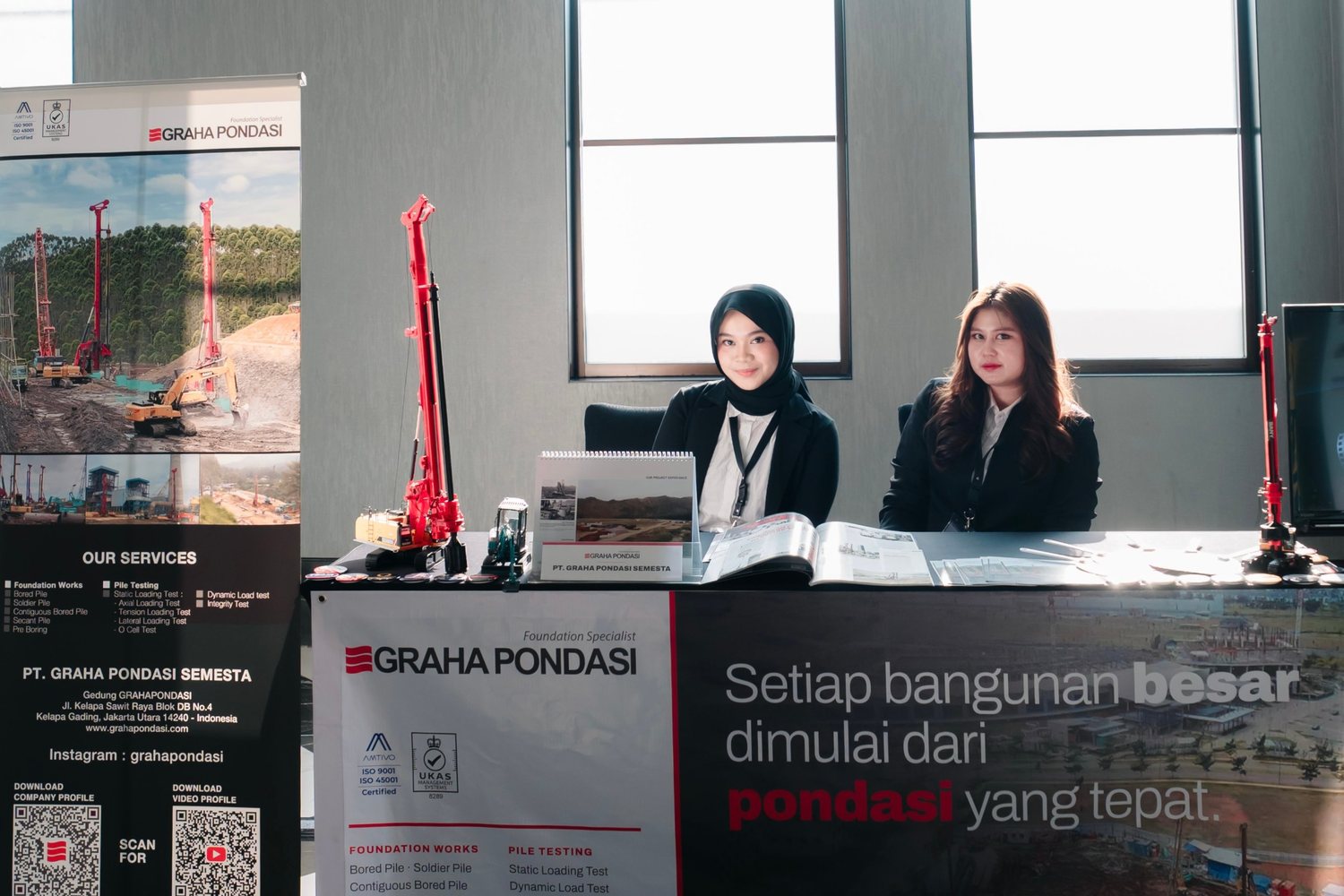
Dalam dunia konstruksi, daftar layanan di banner kami penuh istilah teknis: bored pile, secant pile, O-Cell. Bagi insinyur, itu bahasa sehari-hari. Bagi pemilik proyek, pengembang, atau siapa pun yang penasaran, bisa terdengar seperti kode rahasia. Mari kita bedah satu per satu, dengan bahasa yang lebih santai.
Bagian pertama: Foundation Works (membangun pondasi)
Bored Pile: paku raksasa yang dicetak di dalam tanah
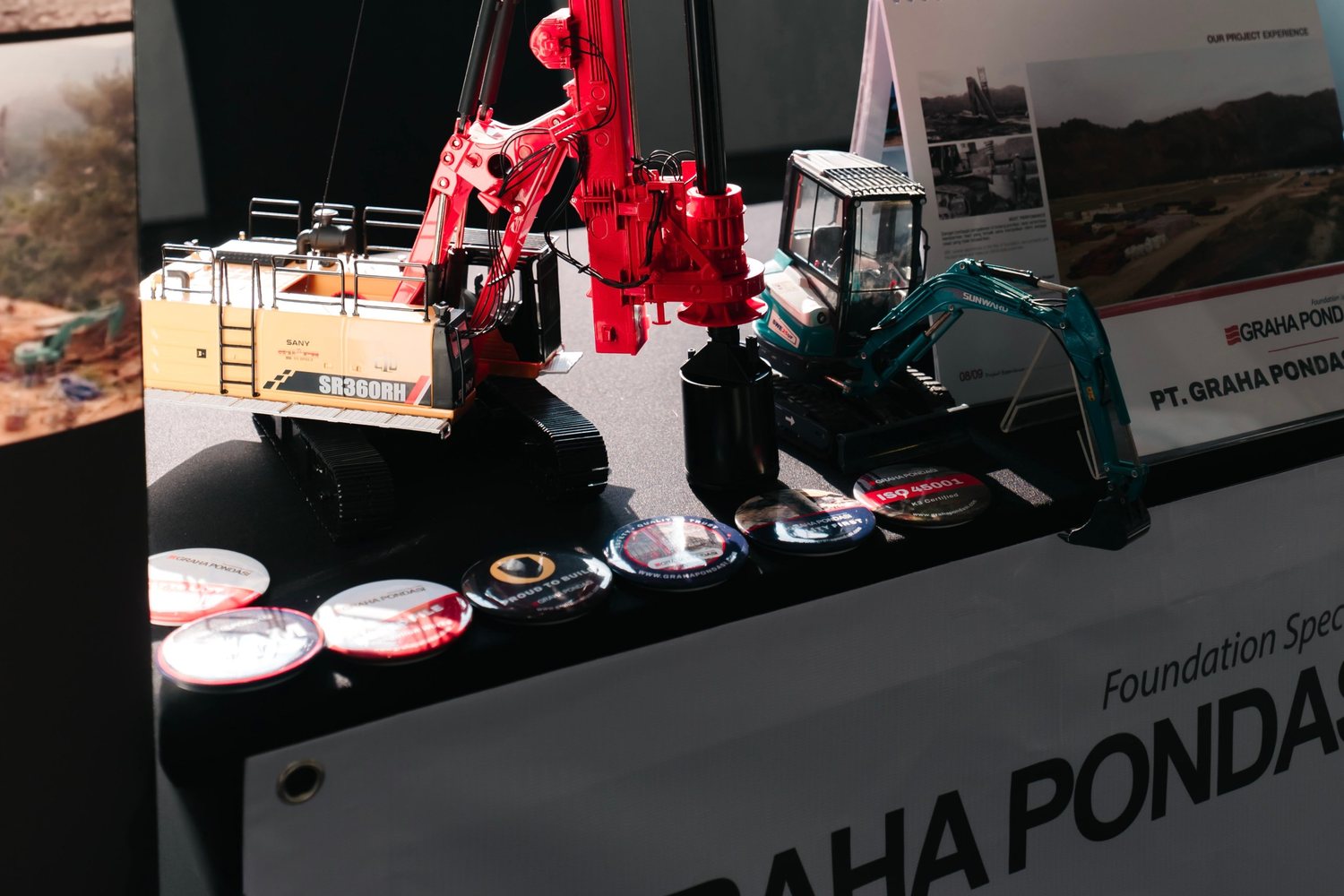
Tanah dibor sampai kedalaman rencana, rangka tulangan baja diturunkan ke dalam lubang, lalu beton dicor. Hasilnya adalah tiang beton bertulang yang menyalurkan beban bangunan ke lapisan tanah yang kuat. Inilah alasan rig bor putar merah di booth kami menjadi bintang pamerannya.
Soldier Pile: barisan penjaga dinding galian
Baja profil H ditanam berjajar untuk menahan dinding galian, misalnya saat basement digali. Metode ini umum dipakai ketika tanah di sekeliling galian perlu ditahan agar tidak longsor.
Contiguous Bored Pile: dinding dari tiang yang berdiri rapat
Bored pile dibuat berderet rapat sehingga membentuk dinding penahan tanah yang kokoh di sekeliling galian.
Secant Pile: tiang-tiang yang saling berpelukan
Mirip contiguous, tetapi tiangnya sengaja dibuat saling berpotongan. Hasilnya dinding yang lebih rapat dan lebih baik menahan rembesan air, pilihan yang tepat ketika galian berada dekat muka air tanah.
Pre Boring: membuka jalan sebelum tiang masuk
Pengeboran awal dilakukan sebelum tiang dipasang, untuk membuka jalan melewati lapisan tanah yang keras dan membantu menjaga gangguan terhadap sekitarnya tetap terkendali.
Bagian kedua: Pile Testing (membuktikan pondasi)
Setelah gedung berdiri, pondasi tak bisa lagi diintip. Karena itu ia harus diuji sebelumnya. Anggap saja ini medical check-up untuk tiang.
Static Loading Test: uji beban yang paling “jujur”
Tiang diberi beban secara bertahap sambil mencatat seberapa jauh ia turun. Pengujian dapat dilakukan ke tiga arah: aksial (ditekan), tension (ditarik), dan lateral (didorong dari samping).
O-Cell Test: menguji tiang dari dalam
Sebuah dongkrak hidrolik khusus (Osterberg cell) dipasang di dalam tiang, lalu mendorong bagian atas dan bawah tiang ke arah berlawanan. Cara cerdas untuk menguji tiang berkapasitas sangat besar tanpa harus menumpuk beban raksasa di permukaan.
Dynamic Load Test: ketukan yang bercerita
Sebuah palu menghantam kepala tiang, sensor merekam gelombang yang merambat, dan datanya dianalisis untuk memperkirakan daya dukung tiang. Prosesnya lebih cepat daripada uji statis.
Integrity Test: mendengarkan gema di dalam tiang
Ketukan ringan dan sensor dipakai untuk “mendengarkan” gema di dalam tiang, sehingga cacat seperti rongga atau penyempitan penampang bisa terdeteksi.
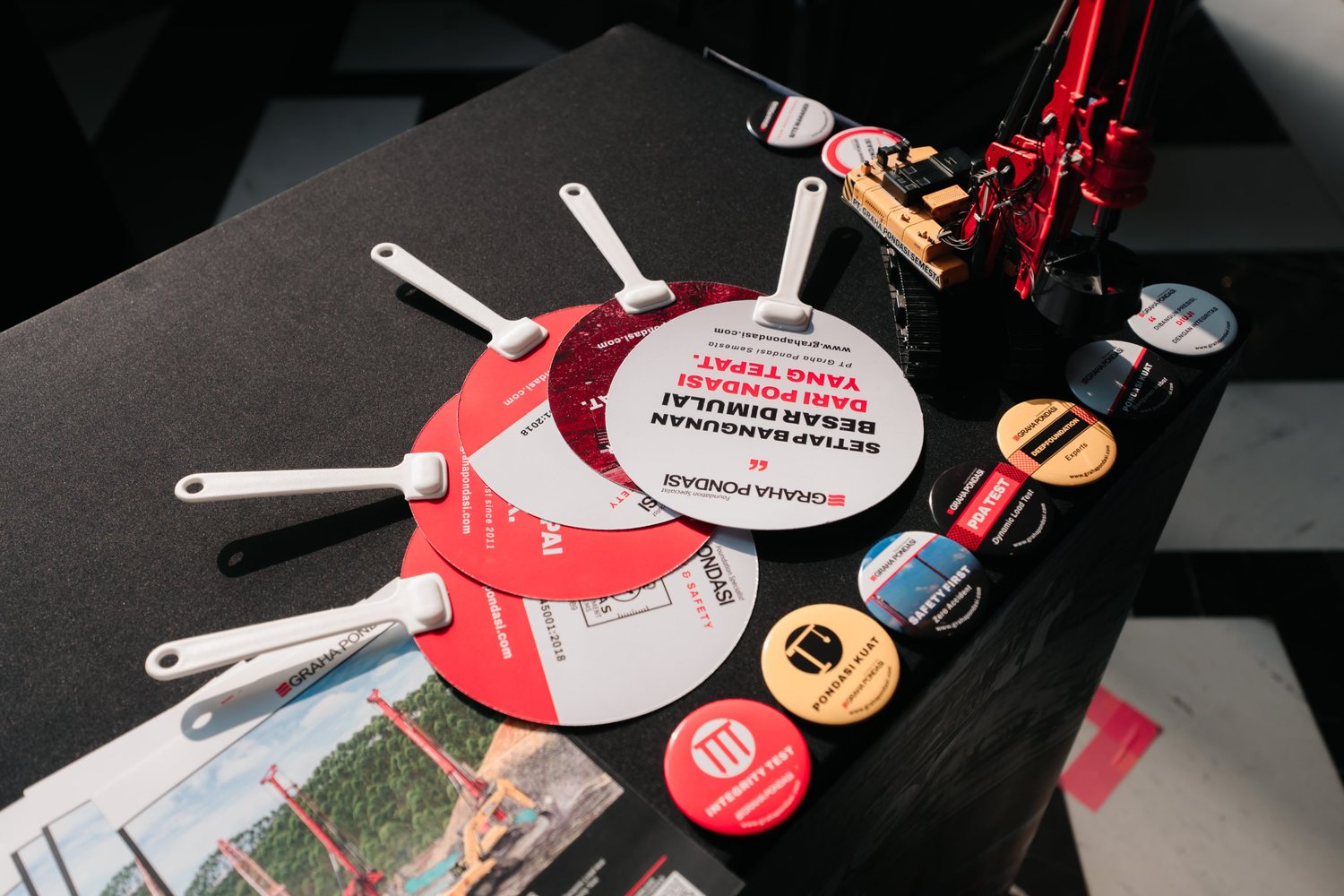
Membangun pondasi adalah separuh cerita. Membuktikannya adalah separuh yang lain.
Bingung memilih metode?
Itulah pertanyaan pertama yang kami ajukan di setiap proyek: tanahnya seperti apa, bebannya berapa, dan lokasinya di mana. Dari situ barulah metode dipilih. Hubungi tim kami untuk berdiskusi.
In the world of construction, the service list on our banner is full of technical terms: bored pile, secant pile, O-Cell. For engineers it is everyday language. For project owners, developers or the simply curious, it can sound like a secret code. Let us go through them one by one, in plain language.
Part one: Foundation Works (building the foundation)
Bored Pile: a giant nail cast inside the ground
The ground is drilled to the planned depth, a steel reinforcement cage is lowered into the hole, and concrete is poured. The result is a reinforced concrete pile that passes the building's load down to strong soil layers. This is why the red rotary drilling rig at our booth was the star of the display.
Soldier Pile: a row of guards for the excavation wall
H-section steel beams are installed in a row to hold back the wall of an excavation, for example when a basement is dug. The method is commonly used when the soil around an excavation needs support to prevent collapse.
Contiguous Bored Pile: a wall of closely standing piles
Bored piles are made side by side, close together, forming a solid earth-retaining wall around the excavation.
Secant Pile: piles that “hug” each other
Similar to a contiguous wall, but the piles deliberately overlap. The result is a tighter wall that holds back water seepage better, a good choice when the excavation is close to the groundwater level.
Pre Boring: clearing the way before the pile goes in
Initial drilling is done before piles are installed, to open a path through hard soil layers and to help keep disturbance to the surroundings under control.
Part two: Pile Testing (proving the foundation)
Once a building stands, its foundation can no longer be peeked at. That is why it must be tested beforehand. Think of it as a medical check-up for piles.
Static Loading Test: the most “honest” load test
The pile is loaded in stages while the settlement is recorded. The test can be carried out in three directions: axial (compression), tension (pulling) and lateral (pushing from the side).
O-Cell Test: testing the pile from the inside
A special hydraulic jack (an Osterberg cell) is installed inside the pile and pushes the upper and lower parts of the pile in opposite directions. A clever way to test very high-capacity piles without stacking enormous weights on the surface.
Dynamic Load Test: a tap that tells a story
A hammer strikes the pile head, sensors record the waves travelling through, and the data is analysed to estimate the pile's bearing capacity. The process is faster than a static test.
Integrity Test: listening for echoes inside the pile
A light tap and sensors are used to “listen” for echoes inside the pile, so defects such as voids or narrowing of the cross-section can be detected.
Building the foundation is half the story. Proving it is the other half.
Not sure which method to choose?
That is the first question we ask on every project: what is the soil like, what are the loads, and where is the site? Only then is the method chosen. Contact our team to talk it through.